
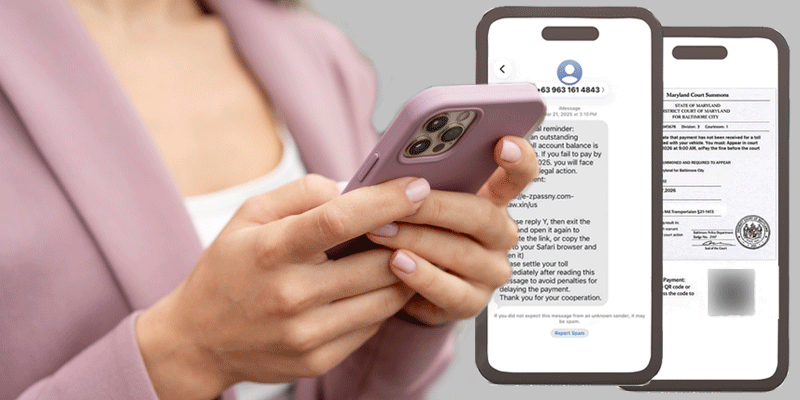
Received a scary looking court summons via text? It’s a scam!
Imagine that you’re sitting in your favorite cafe, sipping a chai latte and suddenly you hear a loud chirp from your mobile phone signaling the arrival of a text. You casually read the text…and then your heartbeat goes into overdrive (and not from caffeine) and your palms become clammy. You’ve just received a text “informing” you of a traffic or toll violation and that you urgently must appear in court or face further prosecution. What’s worse is that there is what appears to be an official-looking court document attached. The message “reassures” you that you can avoid making a court appearance by providing an immediate payment and they have “conveniently” provided a QR code (or link) for that purpose. If you fall for this scam, you’ve just provided a payday for the fraudster on the other end.
Text messages (along with emails and robocalls) claiming to be from a court or simply demanding payment for a traffic ticket or toll violation have become of late a widespread scam. Courts, regardless of jurisdiction, never send legal summons, notify you of hearings, or demand payment via text message, links, or QR codes. These scammers often use urgent variations of “this is your final notice” verbiage and even threaten arrest warrants to pressure their intended victims into payment of a nominal fee or “penalty” immediately.
In an attempt to make their texts appear legitimate, scammers may attach fake and somewhat convincing-looking documents. These bogus documents may feature official-sounding case numbers and fake judge signatures, and even forged court seals to further appear legitimate. The fraudster’s ultimate goal is to coerce their victims into scanning a QR code or clinking a link, either of which will take you to a fake website created to steal your credit card details or infect your phone with malware.
What to do once you receive a such a text
1. Do not click any links or scan any QR codes.
2. Do not reply to the text or call the provided number.
3. Take a screenshot for your records and delete the message.
4. Verify the claim by contacting the court directly using an official number or website. Some potential victims have even visited the court listed to verify, in person, that nothing was amiss.
More Information on fake court texts
Watch out for fake court messages
Some people are getting fake texts, calls, or emails that look like they’re from the court. These are scams. They often say you owe money for a traffic ticket and ask you to pay right away.
Helping the public navigate the rise in texting scams
Courts across the country are seeing a sharp increase in scam text messages, emails, and phone calls. The National Center for State Courts (NCSC) has gathered examples from court leaders in Arizona, Delaware, Maryland, Missouri, New Jersey, Oregon, South Dakota, and Virginia, all reporting similar fraudulent activity.
That text about a traffic violation is probably a scam
Did you get a text with a picture of what looks like an official notice of a traffic hearing? You’re not alone. The FTC has seen a spike in reports about this text scam in the last month. It’s just the latest story of how scammers are trying to separate people from their money. Here’s how this scam works — and how to avoid it.